
On Self-Definition
Also, I bought a pair of boots.

Those of you who have been reading my Substack for a while know that this is the time of year when I begin my annual rant about winter shoes. To recap: I hate winter shoes. And when I say winter shoes, I mean footwear that is meant for actual winter conditions in the Nordics. We have ice and snow here, and winter lasts for months. Shoes that are suitable for our winter tend to be overdesigned, ugly, and full of weird details like contrasting stitches, straps, buckles, stretchy panels, fur details, pom poms, sporty elements, and sometimes all of the above. Winter shoes are abominable.
Last year I bought a pair of basic black combat boots. They got me through the winter, but I didn’t love them. The overall look was too bulky for my liking, and the leather was so hard that my feet ached. My winter shoe search has been continuing for the last several months. My requirements: black, tall, flat lace-up boots with a decent but not monstrously chunky sole, either a warm lining or space for a wool sock, no straps, no buckles, no pom poms, no fur, no reflective details, and nothing that screams après-ski. And finally, after what felt like a never-ending search, I came across these boots.
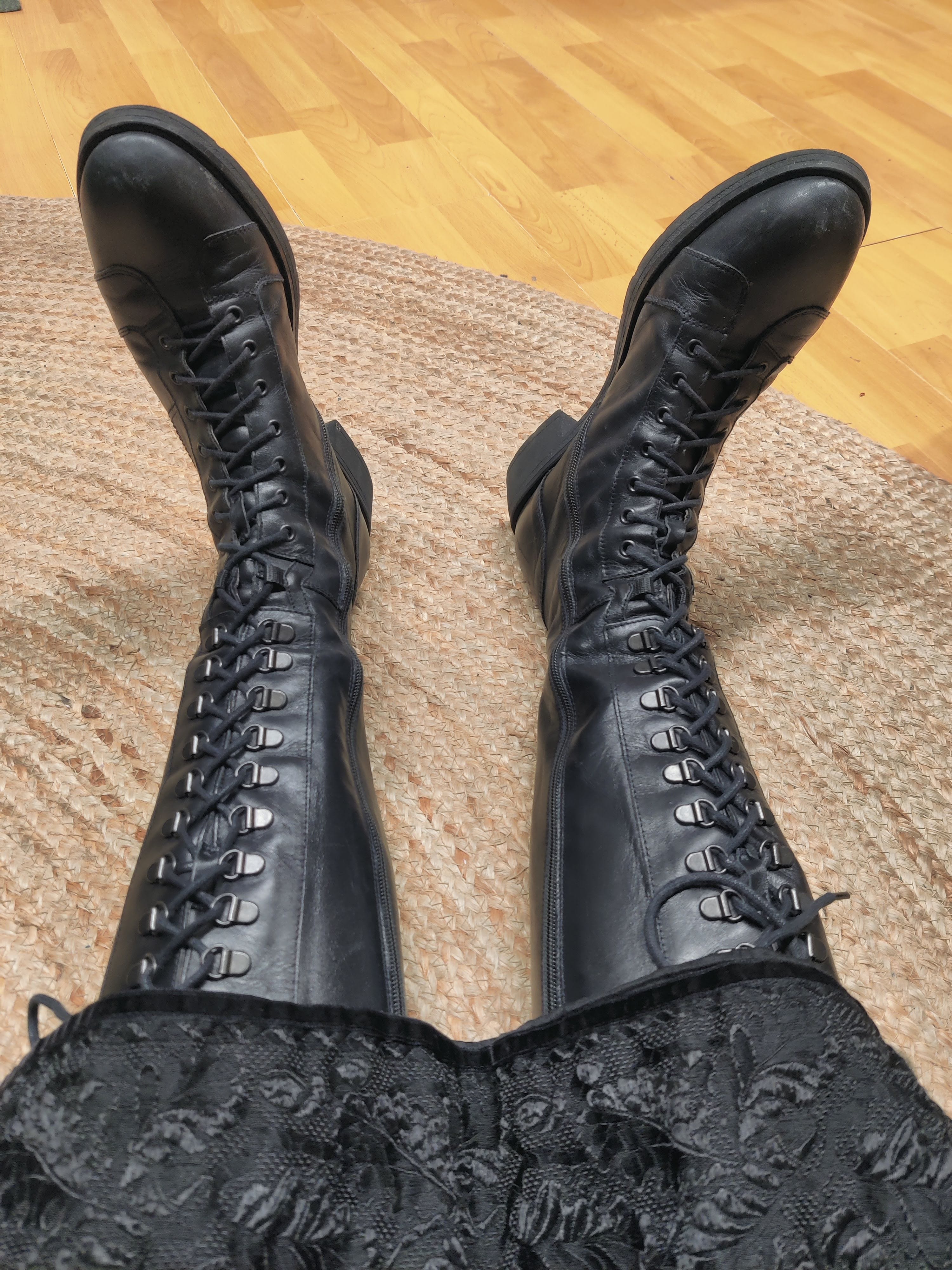
Dear reader, they fit really well. The leather is thick and soft. There’s enough room for a wool sock and a thermal insole. The boots have double zippers which I don’t love, but the zippers are black and fairly unnoticeable. The only unnecessary detail is a single brass grommet at the ankle. I can live with it, because these are pretty much the perfect boots. They are extremely comfortable to wear. The only remaining question is their traction. So far December has been snowless in southern Finland, so I have yet to test the boots in the conditions that I need them for. The soles are made of rubber and they look promising, but I can only hope that they prevail. We’re so close!
The purchase of the boots derailed my goal to stay under 25 new items for 2025, but I really don’t care. The boots are good. I also bought an early 1900s cotton nightshirt after my most recent tally of purchases last month, so I’m now at 26 pieces. I might end up selling the shirt though, because it has a lot of lace and ruffles. I don’t know if I’d wear it, and I keep asking if it’s “me”. I decided to give this question some time to simmer in my mind, because I’ve been rethinking about what “me” is.
Earlier this week I came across an Instagram reel by a Finnish psychologist1 about how our constant attempts at self-definition might be causing us anxiety. What we wear, what we eat, how we vote, what we believe in, or what kind of music we listen to – we tend to categorize ourselves on the basis of our choices. This kind of continuous, subtle narrative-building regarding the self is normal and necessary for forming an identity, but social media throws a spanner in the works. These days a simple choice of dessert portrayed on Instagram might be seen as something that defines the self and strengthens your personal brand. Are you a cake person or an ice cream person? Cupcake or strudel? In this framework, every choice can make or break your portrayal of yourself, so we are constantly defining ourselves, for ourselves and for our social media audience.
On social media we curate and present our interests, our likes and dislikes as if they were a seamless whole, so that we appear consistent to our followers. Instead of building an identity, where our choices and our identity are in constant conversation with each other and always subtly changing, we hone ourselves according to our personal brand whose narrative we dictate from above. There’s very little room for change, error or variation, and in the end, it’s no longer about us on the inside, but about how we should be perceived by others. Our identity becomes performative and self-fulfilling.
While we all know that what we see on social media is not the whole truth, I think it’s still worth investigating the limitations of this type of self-definition. It can feel alluring to constantly define oneself, because in some ways it makes us feel settled and in control, and well, everyone is doing it these days, whether it’s by talking about their style words, posting a photo of their healthy lunch every day, or sharing their Spotify Wrapped at the end of the year.
With endless self-definition, an obligation to comply emerges. We become what we post, so you make sure your daily outfits match your previously chosen style words, and you most likely won’t post a picture of your lunch that one day when you just grabbed a grubby burger at McDonald’s. I keep seeing people posting their Spotify Wrapped on Instagram with various disclaimers to explain why an artist whose music doesn’t quite fit the overall vibe is there. (“My partner used my account! My children like this band! This is my workout music!”)
Self-definition in front of others makes it harder for you to explore other options or to change your mind later. Your pool of inspiration becomes smaller and your choices fewer. The louder you have shouted from the rooftops that you love to travel, the harder it might be to later admit that your values don’t align with air travel’s disastrous ecological footprint. The more often you’ve told your social media followers that you’re a minimalist, the more difficult it might be for you to wear loud prints or ruffles. (I spent a couple of years sharing my daily outfits on Instagram, only to find that posting my outfits for others to see was actually beginning to dictate and redefine my style. I had to quit OOTDs completely to get my bearings.)
In this game, if you change, you’re expected to explain yourself. In order to save face, you will have to keep defining yourself and explaining your choices, to keep peeling the onion. That can be a lot of work. And people do change. We are complex, curious creatures, and we also make mistakes, but social media doesn’t make it easy for us to show it. We’re all products here, and products need to be consistent. Our stories must make sense, and especially if we’ve failed to live up to the image we’ve created of ourselves, it can be exhausting.
That’s a very long explanation for why I’m not going to say that the frills on that antique nightshirt I bought are not “me”. I’m trying to tap into my likes and dislikes rather than complying with an assumption based on my previous choices. I’ll probably end up keeping the shirt because it’s very pretty and I love it, and if I don’t find myself wearing it, well, then that’s another story!
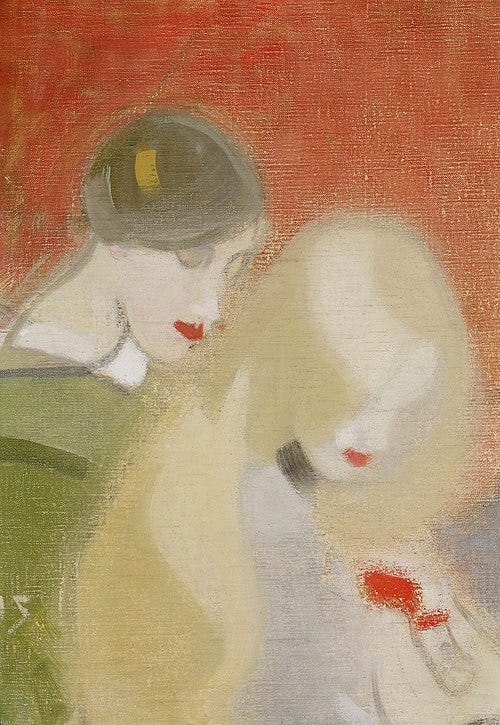
Before I sign off, I wanted to mention that The Metropolitan Museum of Art is hosting an exhibition of Helene Schjerfbeck’s work. Schjerfbeck (1862 - 1946) is probably the most significant Finnish artist of the modernist era. (I’ve mentioned her previously here.) Her use of color is sublime, and those interested in fashion and style will love the attention to clothing, accessories, hair and make-up in her paintings. Go see the exhibit if you happen to be in New York! “Seeing Silence: The Paintings of Helene Schjerfbeck” is at The Met through April 5, 2026.
Sadly I lost the reel after watching it, so I can’t credit the person behind it.
I always need you to sound out the words I can’t write myself.
I’ve missed you and your thoughtful insights, Tiia. 🫶🏻